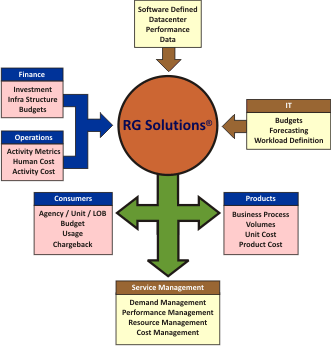
Intelligent Costing
The integration of
performance, financial, and
operational data within a
usage based model that
understands shared
resources and differing OS
platforms will result in the
fair allocation of IT service
costs to the business
consumers. This type of
model provides a low cost
and robust solution that
can span the entire scope
of IT business services.
Link Cost to the Business
Provides for the
designation of business
cost centers and controls
the cost allocations to
these cost centers through
ABC techniques. This
ensures that IT service
costs are linked to desired
business functions. The
result is the ability to
measure the value of IT
services provided to the
business.
More Effective Control
Provides more control over
the IT service costs using
traditional business
methods (i.e. Budgets,
Forecasting, etc.). These
methods assign cost
responsibility to the
consumer. This results in
better business
communications and a
more intelligent use of IT
service resources.
Usage Based ABC Model
The cost calculations within RG
Solutions® are based on a metered
usage model using ABC methods for
allocations. This metered model
accommodates different systems, OS
platforms, and configurations. The model
also uses a SOA framework for the
identification and calculation of isolated
costs, shared costs (i.e. databases, web
servers, etc.), consumer costs (usage),
and product costs (i.e. unit cost, volumes,
etc.).
The user has complete control over
the costing strategy that is used. The use
of hierarchal Cost Pools links consumer
processing to one or more contracts or
expense groups that may or may not be
shared. Strategic to Cost Pools is the
inbuilt ability to forecast future workloads
and have automatic cost calculations,
even if the associated Cost Pools change.
For even greater control over the costing
process, the user has the ability to set the
rates for the individual elements of the
costing process regardless of the IT
service.
Integrated Data
The basis of rock solid cost allocation is the ability to collect and maintain IT performance
information. The core foundation of RG Solutions® is based on Capacity Planning principals and as
such knows how to automatically collect, process, and maintain this data. Include the ability to
integrate external financial and operational data and you have the capability to deliver detailed IT
service data in the business’s native terms.
The user determines how shared costs are applied, directed, and accumulated for similar lines of
business, products, or other business metrics. The hierarchical structure of the internal data allows
for quick analysis of business units, products, value chains, or any other business metrics. Data views
have a one-to-one relationship between consumer cost and the underlying technical data. Forecasting
can be done by the consumer in business terms and then accurately translated into technical
requirements.
Business Oriented
User definition, control, and reporting of the IT service costs allow RG Solutions® to provide cost
views and metrics that are business centric. Cost information can be viewed in different contexts (i.e.
product, consumer, LOB, technical, etc.). Results can be used for chargeback, reporting, or other
means of control. This allows for usage analysis, cost optimizations, price transparency, or other
related business IT service issues.
The main benefit of Cost Transparency is the alignment of IT with the business, and is done so by
linking IT services with consumers. This process includes Finance, IT, and consumers that will define,
understand, and manage the cost of IT services. It puts the responsibility of IT service cost into the
domain of the service consumer, as well as IT.
Better Control
There are additional benefits to a Cost Transparency program. Since IT service costs are linked to
the business, it is possible to use standard business practices to manage the costs. RG Solutions®
supports budgets, forecasting, chargeback, bill of ITs, and other methods that increase
communications and focus decisions regarding IT services.
A Cost Transparency program does not only benefit the business consumers, but there are huge
benefits for the IT group as well. A targeted program allows for better control over the Service
Management resources. Since RG Solutions® is based on capacity management data; it is possible to
better manage the life and performance of the underlying resources. Couple this with the ability for
consumer forecasting and IT is better equipped to manage the demand for IT resources. Finally, with
better cost knowledge and control, the IT group can establish a program of continuous improvement
and cost optimization.